Lip balm and glosses continue to be highly sought-after products year-round, especially during colder months. While many focus on the formulation, the lip balm label and its design are critical assets for marketing and consumer appeal. This guide provides essential information for creating effective lip balm labels, covering design considerations, material choices, application tips, and regulatory compliance.
Understanding Lip Balm Label Requirements
Lip balm labels serve multiple purposes: conveying brand identity, providing essential product information, and complying with regulatory standards. The limited surface area of lip balm containers necessitates careful planning to include all necessary details.
FDA Regulations and Labeling
The Food and Drug Administration (FDA) oversees the labeling of lip balms, categorizing them primarily as either cosmetics or drugs, depending on their claims and ingredients. Understanding these distinctions is crucial for accurate labeling.
Cosmetic vs. Drug Lip Balms
- Cosmetic Lip Balms: Marketed towards general consumers for treating dry lips, they may feature various flavors and glosses. Their primary purpose is to clean, beautify, or improve the look and feel of lips without making medical claims.
- Drug Lip Balms: Intended to treat, heal, or prevent specific conditions (like dry mouth or symptoms), these often contain active medicinal ingredients. They require a drug facts panel, detailing active and inactive ingredients, intended uses, and warnings.
It's important to note that a single product can be classified as both a drug and a cosmetic under FDA regulations. For example, a lip balm with SPF protection is a cosmetic for beautification and a drug for sun protection.
Key Information Required on Lip Balm Labels
Regardless of whether a lip balm is classified as a cosmetic or a drug, certain information must be clearly displayed on the label, adhering to FDA and Fair Packaging and Labeling (FP&L) Act regulations.
Mandatory Label Elements
- Name of Product: This includes the company's legal and patented name, along with its common name.
- Net Quantity of Contents: The amount of product in the container, listed by net weight (customary and metric measurements). For solid products like lip balm, net weight is required.
- Ingredients List: All components must be listed in order of predominance by weight. Colorants are always listed last. For ingredients composed of sub-ingredients (e.g., preservatives), these sub-ingredients must also be listed.
- Directions for Safe Use: Clear instructions on how to use the product. For lip balms, this typically includes "For external use only."
- Warnings: Potential risks, including allergies and specific usage precautions. For cosmetics that do not include a warning statement, they can be considered misbranded.
- Manufacturer Information: The name and place of business where the product was produced.
- Drug Facts Panel (for Drug Lip Balms): This panel details active ingredients, purpose, warnings, directions, and inactive ingredients, following a specific format.
English Language Requirements: All required label elements must be in English. If a label includes foreign language statements, the required legal elements must still appear in English.
Font Size and Legibility
Font size requirements are critical for ensuring information is legible. For most lip balm labels, the typeface for general information should be at least 1/16 inches in height. For smaller labels with a total area less than 12 square feet, a reduced scale of 1/32 inches may be permissible for certain elements. Warning typeface must be at least 1/16 inches in height.
Designing Effective Lip Balm Labels
Beyond regulatory compliance, a well-designed lip balm label attracts customers and reinforces brand identity. Several factors contribute to an effective design.
1. Determining the Right Label Size and Shape
The size and shape of your label are paramount for a proper fit and optimal information display. Standard lip balm tubes (0.15 oz) typically measure around 2.65 inches tall with a 0.6-inch diameter. For these, a label size of approximately 1.75 inches high by 2.125 inches wide is often suitable.
Key Considerations for Size and Shape:
- Container Size: Match the label to the specific dimensions of your lip balm container (tube, jar, tin).
- Information Display: Ensure enough space for all necessary text (ingredients, brand name, directions, warnings) while maintaining aesthetic appeal.
- Custom Shapes: For unique containers or to add a distinctive brand element, consider custom-shaped labels. Tamper-evident perforations are also important for tube containers.
Tip: Before committing to a print run, print a sample label on paper and wrap it around your container to check the fit and ensure no information is cut off or distorted.
2. Choosing the Right Label Materials and Finishes
The material and finish of your lip balm labels significantly impact their durability, appearance, and ability to withstand product contents and environmental factors.
Durable Label Materials
- Polyester Labels: Made from polyethylene terephthalate (PET), these are highly durable, resistant to tearing, moisture, chemicals, and UV radiation, making them suitable for harsh conditions.
- Vinyl Labels: Made from polyvinyl chloride (PVC), vinyl labels are also durable, flexible, and adhere well to curved surfaces. They are waterproof and oil-resistant, ideal for products that may be exposed to moisture or oils.
- BOPP (Biaxially Oriented Polypropylene) Labels: Often used for roll labels, BOPP offers excellent durability, especially when laminated, protecting against harsh elements.
- White Polyester Weatherproof Material: For labels on sheets, this material is compatible with laser printers and offers weatherproof, high heat-resistance, and tear-resistant properties.
Finishes for Protection and Aesthetics
- Matte Finish: Provides an understated, elegant, and non-reflective appearance, often preferred for brands with a natural or minimalist aesthetic.
- Glossy Finish: Offers a shiny, polished look that can make colors pop and draw attention, suitable for vibrant and dynamic brands.
- Laminate Finish: Adds an extra layer of durability, protecting the print from scratches, moisture, and UV exposure.
- UV Coatings: Provide additional protection and can enhance flexibility.
Tip: Given that lip balm is often a bit slick and containers can be exposed to heat or moisture, select labels that are waterproof, oil-resistant, and have a permanent adhesive to ensure they stay in place.
3. Design Elements and Readability
Effective design balances aesthetics with clear communication.
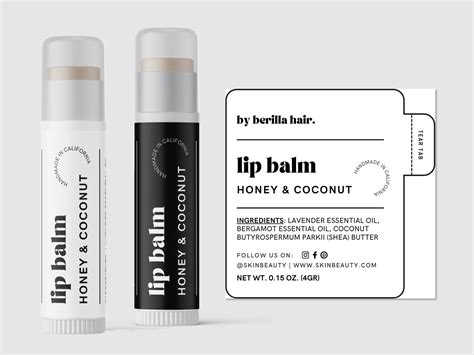
- Simplicity: Focus on core brand elements like your logo, product name, and key information (flavor, scent). Avoid cluttering the label with excessive text or imagery.
- Color and Fonts: Use colors that reflect your brand and offer sufficient contrast for legibility. Opt for clean, simple fonts that are easy to read, even at small sizes.
- Brand Consistency: Ensure your label design aligns with your overall brand identity, using consistent colors, fonts, and logo placement across all your products.
- Call to Action (CTA): Consider adding a simple CTA, such as "Visit us online" or a branded hashtag, to encourage customer engagement.
4. Special Features: Seals and Extended Content
- Tamper-Evident Seals: These are crucial for consumer safety, indicating whether the product has been opened. They are often included on custom lip balm tubes.
- Extended Content Labels (ECLs): For situations where space is extremely limited, ECLs can unwrap from the package to display more detailed information about ingredients, usage, or product properties.
Printing and Application Methods
Choosing the right printing method and application technique ensures high-quality, compliant, and well-adhered labels.
Printing Options
- DIY Printing: For startups or small batches, you can print blank sheet labels at home using a compatible high-quality printer.
- Custom Printing Services: For professional results, order premium labels from custom printing services. These services often offer a wider range of materials, finishes, and the option for security seals. Many providers offer online design tools and proofing processes.
Label Application Best Practices
Proper application is key to achieving strong adhesion and a flawless finish.
- Clean and Dry Containers: Ensure your lip balm containers are thoroughly cleaned and completely dry before applying labels. Any dust, oil, or moisture can compromise adhesion.
- Proper Alignment: Carefully align the label to ensure it fits snugly and evenly around the container without wrinkles or bubbles.
- Smooth Application: Apply steady pressure as you wrap the label around the container to achieve a smooth, professional finish.
Testing: It's advisable to test your labels under real-world conditions. This includes checking their durability against moisture, oils, scratches, and temperature fluctuations, as well as their adhesion on different container surfaces (smooth, textured, frosted).
Labeling Lip Balm Tubes - Lip Balm & Vial Attachment for Junior Labeler | SoapEquipment
Shipping and Production Times
Understanding production and shipping timelines is essential for managing inventory and customer expectations.
- Production Times: Standard production time for custom printed orders is typically 4 business days after proof approval. Blank labels usually ship within 1-3 business days. For custom label and sticker orders, allow 4 business days for production after proof approval (excluding weekends and holidays).
- Shipping Times: Shipping time refers to the transit duration after the order has been produced and shipped. For example, 2-day shipping means the order will be in transit for 2 days, not that it will be shipped within 2 days.
- Order Processing: Order processing times depend on the item and quantity. Orders containing multiple products will have their turnaround time determined by the item with the longest production lead time.
- Expedited Options: Expedited printing and shipping services are available for an additional fee, often offering 2-day or 24-hour rush options for printing.
- Free Shipping: Free shipping may be offered on certain orders, but it typically applies only to standard shipping methods and does not include expedited or alternative shipping options. Always check the checkout process for applicable shipping methods.
Note: It is strongly encouraged to review and approve proofs promptly to avoid production delays.
Choosing the Right Materials for Durability
When selecting materials for lip balm labels, consider the product's nature and its intended use. Roll label materials, particularly BOPP options with lamination, are highly durable and protect against weathering elements. For labels on sheets, white polyester weatherproof material is a recommended choice due to its compatibility with laser printers and its inherent weatherproof, high heat-resistance, and tear-resistant properties.
Vinyl labels are also a reliable choice, offering water and oil resistance, flexibility, and durability, making them suitable for products that might encounter moisture or be handled frequently.
Sustainability in Labeling
As consumer awareness of environmental issues grows, opting for sustainable packaging is increasingly important. Consider using recycled or biodegradable materials for your labels. These eco-friendly options can provide the necessary durability while minimizing environmental impact. Communicating your commitment to sustainability on the label can resonate with environmentally conscious customers.