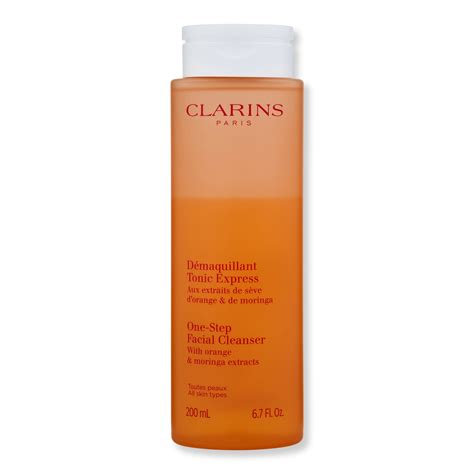
The Clarins One-Step Facial Cleanser is a 3-in-1 product designed to gently polish away makeup, impurities, and pollution, leaving the skin feeling soft, smooth, hydrated, and refined. It also aids in clearing clogged pores and reviving the skin's natural radiance.
Key Benefits and Features
This cleanser is formulated to provide multiple benefits in a single step. It gently polishes away makeup, impurities, and pollution, contributing to skin that feels soft, smooth, hydrated, and refined. Furthermore, it assists in clearing clogged pores and restoring the skin's natural radiance.
The product is described as a quick and effective gel cleanser with natural exfoliating beads that remove makeup, exfoliate, and cleanse while soothing and maintaining the skin's natural moisture balance. It is suitable for all skin types and has been noted by users to be very effective for oily/combination skin, helping to fade post-acne marks and resulting in smoother, brighter skin tone.
Key Ingredients and Their Functions
Clarins One-Step Facial Cleanser features a blend of beneficial ingredients, including:
- Gentle Complex (Organic Golden Gentian* + Organic Lemon Balm Extracts*): These ingredients work to soothe and soften the skin. The organic ingredients are produced in accordance with European regulation (CE 2018/848).
- Organic Kiwi Extract*: Known for its energizing properties, it helps to boost the skin's radiance.
- Organic Soapwort Extracts*: These provide a gentle foam that effectively removes dirt and grime, promoting a clean, balanced, and clear complexion.
- Moringa Seed Extract: This extract purifies and refines the skin while helping to preserve its natural moisture balance.
- Plant-Based Microbeads: These gently exfoliate the skin, clearing impurities for a fresh and clean complexion.
User Experience and Research Results
Consumer tests and user feedback indicate significant positive results:
- Research Results:
- 99% of users reported clean and clear skin after one use.
- 98% of users reported soft skin after one use.
- 98% of users found the exfoliating grains to be soft.
*Consumer test - 103 women - after one use - tested for 14 days.
- User Testimonials: Many users express satisfaction with the product's effectiveness, noting its gentleness despite its exfoliating properties. The pleasant scent and texture are also frequently praised. One user specifically mentioned its effectiveness in fading post-acne marks, leading to a smoother and brighter skin tone. The product is described as having a peach color and needing only a small amount to create a lather.
Detailed Ingredient Breakdown
A closer look at the ingredients reveals their specific roles:
- AQUA/WATER/EAU: The most common cosmetic ingredient, serving as the primary solvent. The water used is purified and deionized.
- SODIUM LAUROYL SARCOSINATE: A surfactant that helps to cleanse the skin.
- GLYCERIN: A humectant that moisturizes and protects the skin by drawing moisture to it. It also has antimicrobial and antiviral properties.
- COCAMIDOPROPYL BETAINE: A cleansing and foaming agent.
- PROPANEDIOL: A multi-tasking ingredient that acts as a solvent, humectant, and penetration enhancer.
- ACRYLATES COPOLYMER: A film-forming agent.
- CELLULOSE: Derived from plants, it acts as a binder and can provide gentle exfoliation.
- COCO-GLUCOSIDE: A gentle cleansing and foaming ingredient.
- CITRIC ACID: An alpha hydroxy acid (AHA) that can exfoliate skin and is often used as a pH adjuster in cosmetic formulations.
- PHENOXYISOPROPANOL: A preservative that prevents microbial growth and extends the product's shelf life.
- MICROCRYSTALLINE CELLULOSE: Derived from cellulose, it acts as a binder and can provide gentle exfoliation.
- SODIUM CHLORIDE: Commonly known as salt, it is used as a thickener in cleansing formulas and an emulsion stabilizer.
- SODIUM LAURATE: A cleansing agent.
- XANTHAN GUM: A thickening and stabilizing agent.
- PARFUM/FRAGRANCE: A blend of ingredients used to give the product a pleasant scent. This term can encompass a wide range of chemicals and plant oils, and may cause allergies in sensitive individuals.
- JOJOBA ESTERS: Emollients that help soften and smooth the skin.
- CAPRYLYL GLYCOL: A preservative booster and emollient.
- DISODIUM EDTA: A chelating agent that stabilizes the product by neutralizing metal ions.
- ACTINIDIA CHINENSIS (KIWI) FRUIT EXTRACT: Provides energizing properties to boost skin radiance.
- SODIUM BENZOATE: A preservative.
- MELISSA OFFICINALIS LEAF EXTRACT: Organic Lemon Balm extract, known for its soothing properties.
- SAPONARIA OFFICINALIS LEAF EXTRACT: Organic Soapwort extract, providing gentle cleansing foam.
- GENTIANA LUTEA EXTRACT: Organic Golden Gentian extract, known for its soothing properties.
- CI 77492/IRON OXIDES: A colorant.
- POTASSIUM SORBATE: A preservative.
- TALC: An absorbent and anti-caking agent.
- CI 73360/RED 30: A colorant.
- MALTODEXTRIN: A carbohydrate derived from starch, often used as a filler or texturizer.
- MORINGA OLEIFERA SEED EXTRACT: Provides antioxidant, anti-inflammatory, and skin-hydrating properties.
Specific Ingredient Concerns and Considerations:
- Cyclopentasiloxane (D5): A silicone used to improve texture and trap moisture. It is lightweight and volatile, evaporating quickly after application while leaving a hydrating barrier. Studies suggest it is safe for skincare, but consultation with a professional is recommended for concerns.
- Isohexadecane: An emollient that enhances texture, emulsifies, and aids cleansing. It is lightweight, non-greasy, and helps moisturize. While generally well-tolerated, some individuals with sensitive skin may experience reactions.
- Sodium Chloride: Primarily used to create a gel-like texture in cleansers.
- Phenoxyethanol: A preservative with germicide and antimicrobial properties. It is often used with Caprylyl Glycol to preserve shelf life.
- Benzyl Alcohol: Primarily used as a preservative, it also has antibacterial and antioxidant properties. It is generally safe in small amounts and can improve texture and spreadability.
- Alcohol (Astringent types): High concentrations can be drying and strip natural oils.
- Parfum/Fragrance: A broad term that can hide numerous chemicals. It is a common cause of contact allergies and sensitivities.
- Benzyl Salicylate: A solvent and fragrance additive, it can be associated with contact dermatitis, though emerging studies suggest it may not be the sole cause. It is listed as a known allergen in the EU.
- Limonene: A fragrance component found in citrus fruits. It acts as an antioxidant but can sensitize the skin when oxidized. Best avoided by those with sensitive skin.
- Benzyl Benzoate: Used as a preservative, solvent, and fragrance component. It can be sensitizing and cause contact dermatitis. It is a known EU allergen.
- Butylphenyl Methylpropional (Lilial): A synthetic fragrance with a floral scent, banned in the EU for rinse-off and leave-on products due to concerns about fertility disruption. It is also a known EU allergen.
- Linalool: A fragrance derived from various plants. It oxidizes on air exposure and can become allergenic.
- Hydroxyisohexyl 3-Cyclohexene Carboxaldehyde (Lyral): A synthetic fragrance.
- Hexyl Cinnamal: A fragrance ingredient with a jasmine-like scent, it is a known EU allergen.
- Citronellol: A fragrance ingredient with a rose-like odor. It can cause allergic contact dermatitis and should be avoided by those with perfume allergies.
- Eugenol: An aromatic oil used for fragrance, it is a known EU allergen.
- Ci 15985: An orange/yellow dye made from petroleum.
How to cleanse your face | ClarinsMen
Application Instructions
Apply a dime-size amount of the cleanser over a damp face and neck. Work into a lather and rinse thoroughly with water.
Sustainability Commitment
Clarins emphasizes its commitment to environmentally friendly practices, particularly at Le Domaine Clarins. Their organic ingredients are grown with optimal traceability, using controlled and sustainable agricultural methods that avoid chemicals and mechanical equipment to protect the natural ecosystem.