Those tiny red dots peppering your skin on your chest, arms, or even face aren't sinister "blood moles" as some call them. They're cherry angiomas, and while they may peek out uninvited, they're often harmless little residents on your skin's canvas. These small, usually flat, and vibrant red bumps are, in essence, clusters of dilated blood vessels. Unlike their mole counterparts, they lack pigment-producing cells.
Cherry angiomas tend to favor the later chapters of life, often gracing adults past 30, and sometimes even children. Interestingly, genetics plays a role, so if your family tree boasts these ruby spots, you might find yourself sharing the spotlight with them. The exact cause of red moles is unknown, but there may be a genetic factor that makes certain people more likely to get them. They’ve also been linked to pregnancy, exposure to chemicals, certain medical conditions, and climate. There also appears to be a link between cherry angiomas and age. They often begin to appear when individuals reach 30 years old and seem to increase in size and number with age.
While they can appear at any age, they are most common in adults 30 and over, and their rate of occurrence increases for the rest of your life. The spots are usually asymptomatic, although they sometimes cause itching and may bleed if they are bumped or torn. They are the result of small veins growing and connecting underneath the skin, which gives them their characteristically red color. While many cherry angiomas are flat, some may appear rounded and look more like a red mole.
Cherry angiomas are red spots or bumps that appear on your skin. They can sometimes also be purple, blue, or even black. They most often affect the trunk and arms, but can also form on your hands, feet, and face. They are neither cancerous nor precancerous. It is not medically necessary to remove them, but some people may want to for cosmetic reasons, or because cherry angiomas sometimes bleed if bumped or agitated.
Spider angiomas are visible, web-like veins that appear just below the outer layer of skin. Spider angiomas are very common. They often occur in pregnant women and in people with liver disease. They can appear in both children and adults. They get their name from an appearance similar to a red spider. They appear most often on the face, neck, upper part of the trunk, arms, and fingers.
Treatment Options for Angiomas
If you’d like to get rid of any bothersome or unsightly cherry angiomas, removal is offered by experienced staff and doctors. They pride themselves on using the most advanced techniques to meet their patients’ needs and goals.
A cherry angioma won’t go away on its own, but it’s also unlikely to cause you any problems. It may bleed from time to time if it’s irritated. Cherry angiomas will not go away on their own but are not malignant. However, they sometimes can look suspicious to a dermatologist until a diagnosis is confirmed.
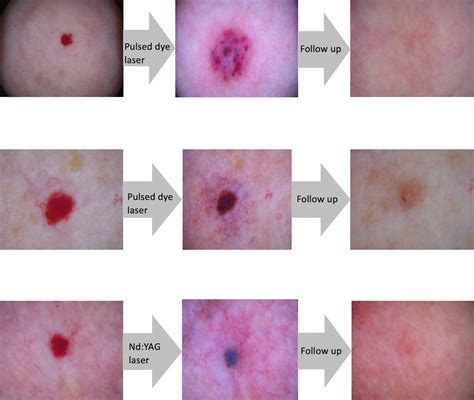
If you are considering cherry angioma removal, know that it is possible for them to grow back over time. Earlier, primitive medical technique options for cherry angioma removal included electrocauterization (burning), cryosurgery (freezing), and even simply cutting them off with a surgical instrument. But the most modern and advanced method is laser removal. The procedure is quick and comfortable and avoids the scarring that previous techniques sometimes produced.
Laser Removal
This cutting-edge technology shines a high-intensity light beam, like a microscopic superhero. It targets the culprit blood vessel with pinpoint precision, causing it to disappear like a shy firework, leaving your skin smooth and clear. Imagine a tiny, controlled spark! Using precise laser technology, skilled teams target unwanted cherry angiomas quickly and effectively-without harming surrounding skin. Laser treatment can cause some slight and temporary bruising, and there can be some brief scabbing.
Electrocauterization
This treatment uses a low-wattage electric current to gently burn off the cherry angioma, offering immediate removal.
Cryosurgery
This method takes on the frost king's mantle, employing liquid nitrogen to freeze the cherry angioma, essentially destroying its frozen form. While effective, it can sometimes leave behind faint white spots, like the fleeting whispers of snowflakes on your skin.
Understanding the Costs of Removal
Choosing the ideal treatment isn't a one-size-fits-all endeavor. Several factors, like the size and location of your cherry angioma, your medical history, and your personal preferences, all dance together to form the perfect solution. Costs will vary according to the number and location of cherry angiomas removed. Discuss options with your doctor.
First step is a free 1-on-1 consultation to assess your lesions. Prices start at $50 and vary depending on size, location, the depth of the lesion, and the technology that will be used. The same one can be treated using Laser and would cost $100.
Talk to your doctor about the cosmetic benefits of removing cherry angiomas.
When to Seek Medical Advice
If you notice any changes in the way a red mole looks, schedule an appointment with your doctor. It’s important to have any type of lesion or growth looked at when its appearance changes or if the diagnosis is unknown. Your doctor will be able to rule out serious conditions, such as skin cancer.
While cherry angioma removal is generally safe and well-tolerated, there are a few situations where it may not be recommended. Individuals who are pregnant, have active skin infections, or are prone to poor wound healing should consult with a skincare professional before undergoing laser treatment. Additionally, people with certain skin conditions or those taking medications that affect skin sensitivity may need to postpone or avoid treatment.
The same treatment can also get rid of the swelling caused by the faulty veins. When your vein’s valves get too loose, they swell up and might stick out from the skin. The swelling can even extend to the tissue around the vein. In addition to the swelling, many people dislike the look of discolored veins on the skin. You might find yourself wearing long pants all year round, or wearing makeup to cover up the problem. Getting rid of discolored veins will give you back the confidence you need to bare your legs.
You might develop more varicose and veins over time, but the ones you get treated will never come back. Most spider and varicose veins are harmless, if unattractive. But some large varicose veins can also threaten your health. It’s important to seek out treatment as soon as possible to prevent serious health problems, like blood clots. Even if your varicose veins don’t feel painful, they can be risky.
Cherry Angiomas: Diagnosis and Treatment | Dermatologist Explains
Understanding cherry angiomas and exploring treatment options empowers you to make informed decisions. This knowledge becomes your shield against anxieties and doubts, allowing you to embrace your skin, imperfections and all, with renewed confidence.