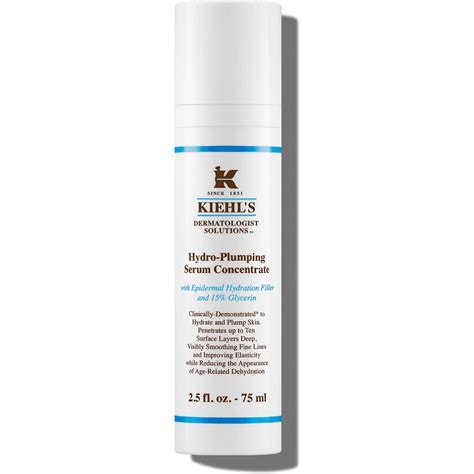
A hydrating serum that plumps skin to improve elasticity and the appearance of dehydrated skin. If you’re after a plump, dewy, and smooth complexion, then look no further; the Kiehl’s Hydro-Plumping Serum Concentrate is here to answer your dehydrated skin’s needs. This hydrating serum visibly improves the appearance of dehydrated skin brought on by a decline in skin's natural Hyaluronic Acid levels while helping improve skin elasticity. It is formulated with Epidermal Hydration filler to encourage skin's natural production of Hyaluronic Acid and improve the appearance of dull skin. The serum helps visibly plump skin to smooth the appearance of fine lines and uneven skin texture.
Key Benefits of Hydro Plumping Hydrating Serum
This hydrating serum is a skin-quenching mix designed to intensively hydrate skin and transform dull, lacklustre, and dehydrated complexions. It delivers a plumping “filling” effect that also improves skin elasticity for an even and bouncy complexion.
- Helps visibly plump skin to smooth the appearance of fine lines and uneven skin texture.
- Formulated with Epidermal Hydration filler to encourage skin's natural production of Hyaluronic Acid and improve the appearance of dull skin.
- Visibly improves the appearance of dehydrated skin brought on by a decline in skin's natural Hyaluronic Acid levels.
- Helps improve skin elasticity.
How to Use
Dispense one pump of this hydrating serum into hand. Apply evenly to clean skin before your moisturizer in the morning and at night.
Ingredient Breakdown
The Kiehl’s Hydro-Plumping Serum Concentrate is suitable for all skin types, including sensitive. The serum has a cool gel texture that erupts into a fluid as you massage it in. It’s very lightweight and instantly refreshes and revives skin.
Core Hydration and Plumping Ingredients
Water (Aqua)
Good old water, aka H2O. It's the most common cosmetic ingredient of all. You'll usually see it at the top of ingredient lists, meaning that it makes up the largest part of the product. The water used in cosmetics is purified and deionized, meaning that almost all of the mineral ions inside it are removed.
Glycerin
Glycerin is a well-known skincare ingredient, it is highly compatible and naturally occurring within skin. It is a powerful humectant known to attract and lock in moisture to the upper surface layer of the skin to help maintain a "filling effect" and visibly smooth dry, fine lines. Glycerin is already naturally found in your skin. It helps moisturize and protect your skin. A study from 2016 found glycerin to be more effective as a humectant than AHAs and hyaluronic acid. As a humectant, it helps the skin stay hydrated by pulling moisture to your skin. The low molecular weight of glycerin allows it to pull moisture into the deeper layers of your skin. Hydrated skin improves your skin barrier; Your skin barrier helps protect against irritants and bacteria. Glycerin has also been found to have antimicrobial and antiviral properties. Due to these properties, glycerin is often used in wound and burn treatments. In cosmetics, glycerin is usually derived from plants such as soybean or palm. However, it can also be sourced from animals, such as tallow or animal fat. This ingredient is organic, colorless, odorless, and non-toxic.
Epidermal Hydration Filler
This ingredient encourages skin's natural hyaluronic acid production to help improve elasticity and visibly reduce signs of age-related dehydration. It is a next generation AHA, a so-called PHA that gently exfoliates skin without irritation. It also moisturizes and helps the skin barrier.
Emulsifiers and Texture Enhancers
Dimethicone
Probably the most common silicone of all. As for skincare, it makes the skin silky smooth, creates a subtle gloss and forms a protective barrier (aka occlusive). Also, works well to fill in fine lines and wrinkles and give skin a plump look (of course that is only temporary, but still, it's nice). Dimethicone is a type of synthetic silicone created from natural materials such as quartz. Depending on the viscosity, dimethicone has different properties. This ingredient is unlikely to cause irritation because it does not get absorbed into skin. However, people with silicone allergies should be careful about using this ingredient. Note: Dimethicone may contribute to pilling. This is because it is not oil or water soluble, so pilling may occur when layered with products. When mixed with heavy oils in a formula, the outcome is also quite greasy.
PEG-10 Dimethicone
A silicone emulsifier that helps water and silicone oils to mix nicely together. It can also be used together with plant oil + silicone oil mixtures. It is a silicone with conditioner and emulsifier properties. According to the manufacturer, acidic formulations decrease the stability of this ingredient. It works best in neutral or near neutral formulations.
Polymethylsilsesquioxane
A spherical texturizing powder that's used as a texture enhancer and soft focus agent. It's claimed to give silicone type softness to the formula and also works as a (temporary) wrinkle filler. It is a silicone used as a film forming agent. When applied to the skin, this ingredient creates an invisible film on the surface. This film still allows oxygen to pass through, but prevents moisture from escaping. This can help condition and hydrate the skin. It also leaves a silky feel when applied. Polymethylsilsesquioxane has not been shown to clog pores. It has been deemed safe to use up to 55%, but most cosmetics use much less.
Preservatives and Stabilizers
Phenoxyethanol
It’s pretty much the current IT-preservative. It’s safe and gentle, but even more importantly, it’s not a feared-by-everyone-mostly-without-scientific-reason paraben. It’s not something new: it was introduced around 1950 and today it can be used up to 1% worldwide. It can be found in nature - in green tea - but the version used in cosmetics is synthetic. Other than having a good safety profile and being quite gentle to the skin it has some other advantages too. It can be used in many types of formulations as it has great thermal stability (can be heated up to 85°C) and works on a wide range of pH levels (ph 3-10). It’s often used together with ethylhexylglycerin as it nicely improves the preservative activity of phenoxyethanol. Phenoxyethanol is a preservative that has germicide, antimicrobial, and aromatic properties. Studies show that phenoxyethanol can prevent microbial growth. By itself, it has a scent that is similar to that of a rose. It's often used in formulations along with Caprylyl Glycol to preserve the shelf life of products.
Chlorphenesin
A synthetic preservative. It helps protect a product against bacteria in order to extend shelf life. In most cases, Chlorphenesin is paired with other preservatives such as phenoxyethanol and caprylyl glycol. Chlorphenesin is a biocide. This means it is able to help fight the microorganisms on our skin. It is also able to fight odor-releasing bacteria. Chlorphenesin is soluble in both water and glycerin. Studies show Chlorphenesin is easily absorbed by our skin.
Disodium EDTA
Plays a role in making products more stable by aiding other preservatives. It is a chelating agent, meaning it neutralizes metal ions that may be found in a product.
p-Anisic Acid
An aromatic compound that is naturally found in some plants. It is mainly used as a fragrance ingredient but also has preservative and antimicrobial properties. The effectiveness of this ingredient as a preservative and antimicrobial depends on the pH (with more acidic being better). This is the reason you'll see this ingredient bundled with other preservatives. Though the official function of P-Anisic Acid is masking (meaning that it helps to mask not so nice smells in the product), according to manufacturer info it is rather used as a preservative. It is a skin friendly organic acid that works against fungi.
pH Adjusters
Sodium Hydroxide
The unfancy name for it is lye. It’s a solid white stuff that’s very alkaline and used in small amounts to adjust the pH of the product and make it just right. For example, in case of AHA or BHA exfoliants, the right pH is super-duper important, and pH adjusters like sodium hydroxide are needed. Sodium hydroxide is also known as lye or caustic soda. It is used to adjust the pH of products; many ingredients require a specific pH to be effective. In small amounts, sodium hydroxide is considered safe to use. However, large amounts may cause chemical burns due to its high alkaline. Your skin has a natural pH and acid mantle. This acid mantle helps prevent harmful bacteria from breaking through. The acid mantle also helps keep your skin hydrated. "Alkaline" refers to a high pH level. A low pH level would be considered acidic.
Citric Acid
Citric acid comes from citrus fruits and is an AHA. But according to a comparative study done in 1995, citric acid has less skin improving magic properties than glycolic or lactic acid. In skincare formulas, citric acid can: While it can provide some skin benefits, research shows lactic acid and glycolic acid are generally more effective and less irritating exfoliants. Most citric acid used in skincare today is made by fermenting sugars (usually from molasses). Citric Acid is an alpha hydroxy acid (AHA) naturally found in citrus fruits like oranges, lemons, and limes. Like other AHAs, citric acid can exfoliate skin by breaking down the bonds that hold dead skin cells together. This helps reveal smoother and brighter skin underneath. However, this exfoliating effect only happens at high concentrations (20%) which can be hard to find in cosmetic products. Due to this, citric acid is usually included in small amounts as a pH adjuster. This helps keep products slightly more acidic and compatible with skin's natural pH.
Sodium Citrate
Sodium Citrate is the sodium salts of citric acid. In skincare, it is used to alter pH levels and acts as a preservative. Its main functions are to maintain the pH of a product and neutralize metal ions. The acidity of our skin is maintained by our glands and skin biome; normal pH level of skin is slightly acidic (~4.75-5.5). Being slightly acidic allows our skin to create an "acid mantle". This acid mantle is a thin barrier that protects our skin from bacteria and contaminants.
Sodium Chloride
Sodium chloride is the fancy name of salt. If (similar to us) you are in the weird habit of reading the label on your shower gel while taking a shower, you might have noticed that sodium chloride is almost always on the ingredient list. The reason for this is that salt acts as a fantastic thickener in cleansing formulas created with ionic cleansing agents (aka surfactants) such as Sodium Laureth Sulfate. A couple of percents (typically 1-3%) turns a runny surfactant solution into a nice gel texture. If you are into chemistry (if not, we understand, just skip this paragraph), the reason is that electrolytes (you know, the Na+ and Cl- ions) screen the electrostatic repulsion between the head groups of ionic surfactants and thus support the formation of long shaped micelles (instead of spherical ones) that entangle like spaghetti, and viola, a gel is formed. Other than that, salt also works as an emulsion stabilizer in water-in-oil emulsions, that is when water droplets are dispersed in the oil (or silicone) phase. Chances are, you eat sodium chloride every day. You'll most likely find this ingredient in cleansers where it is used to create a gel-like texture. As an emulsifier, it also prevents ingredients from separating. There is much debate on whether this ingredient is comedogenic. The short answer - comedogenic ratings don't tell the whole story. The consensus about this ingredient causing acne seems to be divided. Research is needed to understand if this ingredient does cause acne. Scrubs may use salt as the primary exfoliating ingredient.
Other Beneficial Ingredients
Propanediol
Propanediol is a natural alternative for the often used and often bad-mouthed propylene glycol. Propanediol is an all-star ingredient. Propanediol is not likely to cause sensitivity and considered safe to use. It is derived from corn or petroleum with a clear color and no scent.
Adenosine
Adenosine is an important little compound in our body that has a vital cell-signalling role. Adenosine is in every living organism. It is one of four components in nucleic acids that helps store our DNA. Adenosine has many benefits when used. These benefits include hydrating the skin, smoothing skin, and reducing wrinkles. Once applied, adenosine increases collagen production. It also helps with improving firmness and tissue repair. Studies have found adenosine may also help with wound healing. In skincare products, Adenosine is usually derived from yeast.
Tocopherol (Vitamin E)
Pure Vitamin E. Great antioxidant that gives significant photoprotection against UVB rays. Works in synergy with Vitamin C. Tocopherol (also known as Vitamin E) is a common antioxidant used to help protect the skin from free-radicals and strengthen the skin barrier. It's also fat soluble - this means our skin is great at absorbing it. Vitamin E also helps keep your natural skin lipids healthy. Your lipid skin barrier naturally consists of lipids, ceramides, and fatty acids. Vitamin E offers extra protection for your skin’s lipid barrier, keeping your skin healthy and nourished. Another benefit is a bit of UV protection. Vitamin E helps reduce the damage caused by UVB rays. (It should not replace your sunscreen). Combining it with Vitamin C can decrease sunburned cells and hyperpigmentation after UV exposure. You might have noticed Vitamin E + C often paired together. This is because it is great at stabilizing Vitamin C. Using the two together helps increase the effectiveness of both ingredients.
Dipropylene Glycol
A synthetically created humectant, stabilizer, and solvent. Dipropylene glycol is technically an alcohol, but it belongs to the glycol family (often considered part of the ‘good’ alcohols). This means it is hydrating and gentle on skin unlike drying solvent alcohols like denatured alcohol. As a masking agent, Dipropylene Glycol can be used to cover the smell of other ingredients. However, it does not have a scent. Studies show Dipropylene Glycol is considered safe to use in skincare.
Potentially Irritating or Controversial Ingredients (Used Safely in This Formula)
Sodium Laureth Sulfate (Implied by Sodium Chloride Function)
While not explicitly listed, the function of Sodium Chloride as a thickener in cleansing formulas implies the potential use of surfactants like Sodium Laureth Sulfate. Sodium Dextran Sulfate is a type of sulfate.