The human body is composed of approximately 200 distinct cell types, each with unique shapes and functions, despite sharing similar internal structures. These cells are organized into tissues, which are groups of cells originating from a common embryonic origin. Tissues exhibit shared morphological features and are arranged in a specific pattern to fulfill particular functions. This tissue-level organization, prevalent in complex multicellular organisms, enhances bodily efficiency by allowing specialized structures to perform specialized tasks.
The four broad categories of human tissues are epithelial, connective, muscle, and nervous tissue. Each category is defined by its specific functions that contribute to the overall health and maintenance of the body. Disruptions in tissue structure can indicate injury or disease.
Epithelial Tissue: An Overview
Epithelial tissue, also known as epithelium, forms sheets of cells that cover the body's exterior surfaces, line internal cavities and passageways, and constitute certain glands. It acts as the body's first line of defense against physical, chemical, and biological wear and tear. Epithelial cells function as gatekeepers, controlling permeability and enabling the selective transfer of materials across a physical barrier. All substances entering or leaving the body must cross an epithelium.
Epithelial tissues are characterized by several key features:
- High cellularity: They are composed of closely packed cells with minimal extracellular material.
- Polarity: Epithelial cells exhibit distinct apical (exposed) and basal (attached) surfaces with different structures and functions.
- Specialized Structures: Adaptations like cilia and microvilli on the apical surface aid in movement and absorption.
- Basal Lamina: A non-cellular layer of glycoproteins and collagen anchors the epithelium and separates it from underlying connective tissue.
- Avascularity: Epithelial tissues lack blood vessels; nutrients are supplied by diffusion or absorption from underlying tissues or the surface.
- Regeneration: Many epithelial tissues can rapidly replace damaged or dead cells.
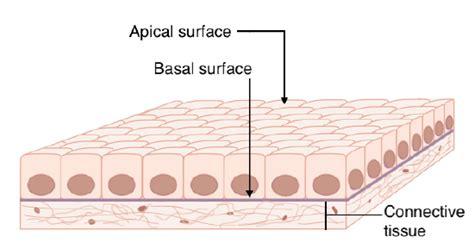
Many epithelial cells are capable of secretion, releasing mucous and specific chemical compounds onto their apical surfaces. For example, the epithelium of the small intestine secretes digestive enzymes, and the epithelium lining the respiratory tract secretes mucus to trap airborne particles and microorganisms.
Classification of Epithelial Tissues
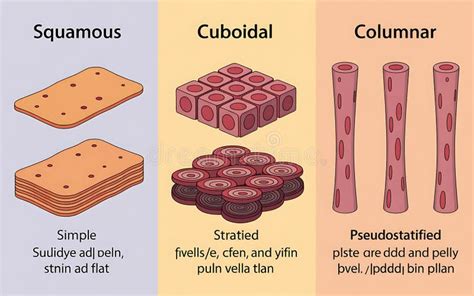
Epithelial tissues are classified based on two primary criteria: the shape of the cells and the number of cell layers.
Cell Shapes
- Squamous: Flattened and thin cells.
- Cuboidal: Boxy cells, as wide as they are tall.
- Columnar: Rectangular cells, taller than they are wide.
Number of Cell Layers
- Simple Epithelium: A single layer of cells, where every cell rests on the basal lamina.
- Stratified Epithelium: More than one layer of cells, with only the basal layer resting on the basal lamina.
- Pseudostratified Epithelium: Appears multilayered due to irregularly shaped cells and varying nuclei positions, but is actually a single layer where all cells contact the basal lamina.
Types of Epithelial Tissues
Simple Epithelia
The structure of simple epithelia reflects their functions, primarily related to diffusion, secretion, and absorption.
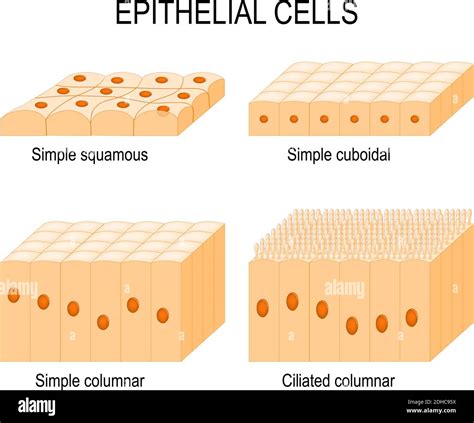
- Simple Squamous Epithelium: Characterized by thin, flat cells resembling scales. Their thinness facilitates rapid passage of chemical compounds. Examples include the endothelium lining blood and lymphatic vessels, the alveoli of the lungs, kidney tubules, and the lining of capillaries. The mesothelium, a simple squamous epithelium, forms the surface layer of serous membranes.
- Simple Cuboidal Epithelium: Features box-shaped cells with round nuclei, typically located centrally. These epithelia are active in the secretion and absorption of molecules. They are found in glandular tissue and kidney tubules.
- Simple Columnar Epithelium: Consists of tall, rectangular cells with elongated nuclei usually located at the basal end. This type is active in absorption and secretion and lines parts of the digestive system and the female reproductive tract. Some simple columnar epithelia are ciliated, possessing cilia on their apical surfaces to move substances.
- Pseudostratified Columnar Epithelium: Appears stratified due to irregular cell shapes and scattered nuclei but is a single layer. All cells contact the basal lamina, though not all reach the apical surface. These epithelia often include specialized cells like mucus-secreting goblet cells and may be ciliated. They are found lining portions of the respiratory tract and some male reproductive tract tubes.
Stratified Epithelia
Stratified epithelia, composed of multiple cell layers, primarily provide protection against physical and chemical wear and tear.
- Stratified Squamous Epithelium: The most common type of stratified epithelium. The apical cells are squamous, while basal layers can be columnar or cuboidal. The top layer may be dead and filled with keratin. This type is found in the epidermis of mammalian skin (keratinized) and the lining of the mouth cavity (non-keratinized).
- Stratified Cuboidal Epithelium: A multilayered epithelium found in the excretory ducts of sweat and salivary glands, and the conjunctiva of the eye.
- Stratified Columnar Epithelium: Also rare, found in the conjunctiva lining of the eyelids, offering protection and mucus secretion.
- Transitional Epithelium: Unique to the urinary system (ureters, urinary bladder). Its cells can change shape, flattening as the bladder fills with urine. When empty, it appears convoluted with cuboidal apical cells; when full, it is stretched and appears less stratified.
Glandular Epithelium
Glandular epithelium is specialized for synthesizing and secreting chemical substances. Glands can be classified as endocrine or exocrine.
- Endocrine Glands: Secrete hormones directly into the interstitial fluid and bloodstream, acting as part of the body's regulatory system.
- Exocrine Glands: Release their secretions through ducts that lead to epithelial surfaces. Examples include mucous, sweat, saliva, and breast milk.
Exocrine glands can be further classified by their structure (unicellular or multicellular) and mode of secretion:
- Unicellular Glands: Such as goblet cells, are single epithelial cells that secrete mucus.
- Multicellular Glands: Can be simple (single duct) or compound (branched ducts) and can have tubular, alveolar (acinar), or tubuloalveolar shapes.
Modes of Secretion
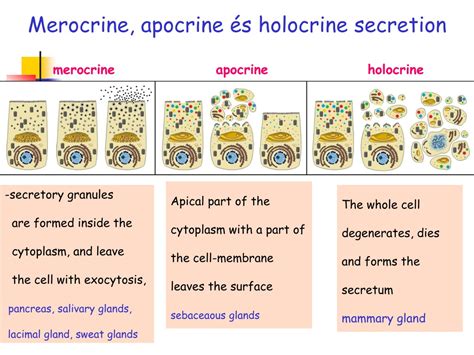
- Merocrine Secretion: Products are released via exocytosis; the cell remains intact. Watery mucus and enzymes are examples.
- Apocrine Secretion: The apical portion of the cell, containing the secretion, pinches off and is released. Sweat glands in the armpit are an example.
- Holocrine Secretion: The entire gland cell accumulates its secretory product and then ruptures and dies to release it. Sebaceous glands of the skin are holocrine glands.
Functions of Epithelial Tissue
Epithelial tissues perform a variety of essential functions, depending on their specific type and location:
- Protection: Forms a barrier against physical, chemical, and biological insults (e.g., skin, lining of the digestive tract).
- Secretion: Produces and releases substances like enzymes, hormones, mucus, and sweat.
- Absorption: Takes in substances from lumens or external environments (e.g., nutrients in the intestines).
- Excretion: Removes waste products (e.g., kidneys, sweat glands).
- Filtration: Filters substances, such as air in the respiratory tract or blood in the kidneys.
- Diffusion: Facilitates the passive movement of molecules across membranes (e.g., gas exchange in the lungs).
- Sensory Reception: Contains sensory nerve endings for stimuli like touch, pain, taste, smell, hearing, and balance.
Tissues, Part 2 - Epithelial Tissue: Crash Course Anatomy & Physiology #3
Disorders Affecting Epithelial Tissue
Due to their high turnover rate, epithelial cells are particularly susceptible to certain disorders:
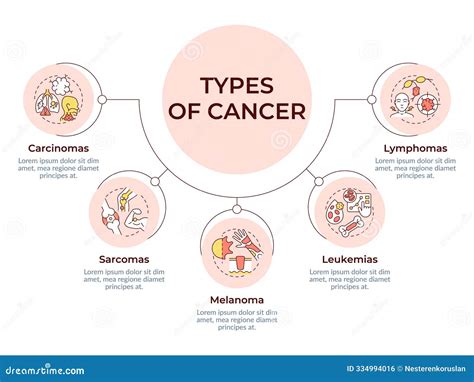
- Cancer: Epithelial tissues are the most common origin of cancers. Benign tumors are called adenomas or papillomas, while malignant tumors are referred to as carcinomas. Examples include adenocarcinoma (affecting glandular epithelium) and papillary thyroid carcinoma.
- Metaplasia: A reversible change in which one differentiated cell type is replaced by another, often in response to chronic irritation or environmental stress. For example, squamous cells in the esophagus can change to columnar cells in response to uncontrolled GERD, increasing cancer risk.
- Other Conditions: Various disorders affect epithelial tissues, including asthma (affecting bronchial epithelium), celiac disease (damaging intestinal microvilli), human papillomavirus (HPV) infections causing warts, and vertigo related to abnormal cell collections in the ear.
tags: #skin #epithelial #tissue