Hair is a filamentous, usually pigmented outgrowth from the skin found exclusively on mammals. It can be found on all areas of the skin except for the lips, fingertips, palms, soles, glans penis, and labia minora. These thin strands grow from hair follicles, which are located in the deeper portion of the skin (dermis), and they protrude through the outer skin layer (epidermis).
Human hair is broadly classified into two main types: vellus hair, which is short, fine, and often referred to as "peach fuzz," growing on most parts of the body in both sexes; and terminal hair, which is longer, coarser, thicker, and darker, representing fully developed hairs.
Humans possess approximately 5 million hair follicles across their body, with about 100,000 located on the scalp. This translates to a density of roughly 130 scalp hair follicles per square centimeter, equating to about 300 to 500 hair shafts per square centimeter. Hair density is influenced by both race and hair color, with Caucasians generally exhibiting the highest hair density and an average growth rate, Asians having the lowest density but fastest-growing hair, and Africans falling in the middle with medium density and the slowest hair growth.
The Structure and Composition of Hair
Each strand of hair is a complex biological structure primarily composed of proteins, water, lipids, minerals, and pigments. The main protein that constitutes hair is keratin, making up approximately 95% of its composition. Keratin provides hair with its strength, resilience, and structure.
Healthy hair also contains an average of 10-15% water, which is essential for its biochemical processes. Lipids, largely derived from the sebaceous glands, act as a protective barrier and contribute to hair's shine. These glands produce sebum, an oily substance that lubricates the scalp and hair, keeping them hydrated and protected.
Minerals such as zinc, iron, copper, and magnesium play a role in hair structure and color. These minerals can also reflect environmental exposure, making hair a useful biomarker for toxicological analyses. Finally, pigments are responsible for hair color. The primary pigments are eumelanin (producing black or brown tones) and pheomelanin (responsible for red and blonde tones). The combination and concentration of these pigments, along with the hair's structure, determine its final color.
The Hair Shaft
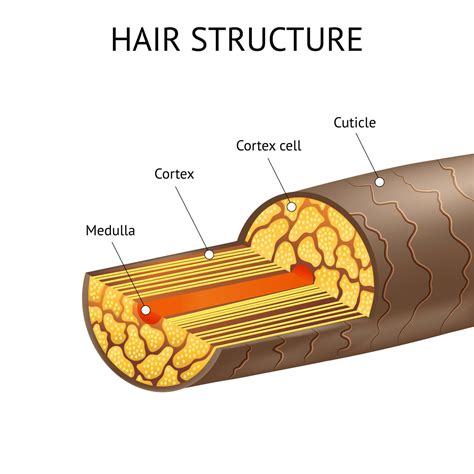
The hair shaft is the visible and tangible part of the hair that emerges from the scalp. Its structure is finely designed and consists of several layers:
- The Cuticle: This is the outermost layer, composed of flattened, overlapping cells resembling scales. These scales interlock to protect the underlying layer, the cortex. A healthy cuticle gives hair a smooth, shiny appearance, while damage can lead to dullness and tangling.
- The Cortex: This is the middle and thickest layer, made up of long cells containing keratin. It houses the pigments responsible for hair color and is crucial for the hair's strength, elasticity, and texture.
- The Medulla: This central layer is not always present, particularly in fine hair, and when it is, it can be discontinuous. Its exact function is not fully understood but may involve nutrient transport.
The Hair Follicle
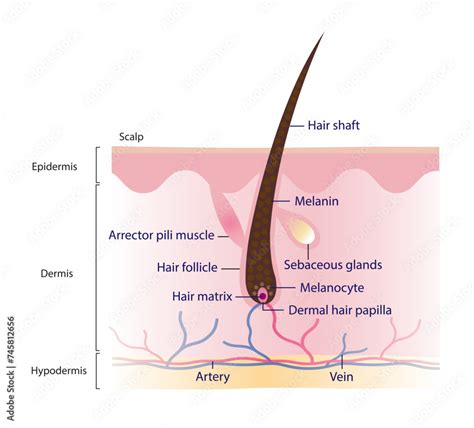
The hair follicle, nested within the dermis, is the living "root" of the hair, where cells divide and keratinize to form the hair shaft. The follicle contains the dermal papilla, a structure rich in blood vessels that supply nutrients for hair growth. The dermal papilla contains specialized cells called fibroblasts that regulate the hair cycle and growth. Surrounding the dermal papilla is the hair matrix, a collection of epithelial cells and melanocytes where cell division leads to the formation of the hair fiber. The hair matrix epithelium is one of the fastest-growing cell populations in the body. The dermal papilla and the matrix together are referred to as the hair bulb.
Sebaceous Glands
Sebaceous glands are closely associated with hair follicles and are responsible for producing sebum. Sebum lubricates the scalp and hair, maintaining hydration and protection. It also forms a hydrophobic barrier, reducing water loss and protecting against external aggressors like bacteria and fungi. Imbalances in sebum production can lead to various scalp and skin issues, such as greasiness or dryness and brittleness.
The Hair Growth Cycle
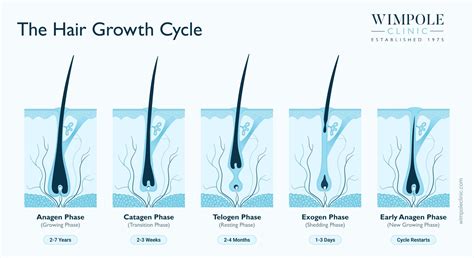
Every hair on our head undergoes a life cycle comprising three main phases: anagen, catagen, and telogen. This cycle determines how long a hair remains on the scalp, its growth duration, and when it falls out. The cycle is influenced by factors such as age, genetics, hormones, and environmental conditions.
- Anagen Phase: This is the period of active hair growth, where hair follicle cells divide rapidly to form the hair shaft. The anagen phase can last from 2 to 7 years, during which hair grows approximately 1 to 1.5 cm per month. About 85-90% of hairs are in this stage at any given time.
- Catagen Phase: A short transitional phase lasting about 2 to 3 weeks, during which hair growth stops. The hair follicle retracts, and the hair bulb gradually detaches from the dermal papilla.
- Telogen Phase: This is the resting phase where the hair does not grow but remains attached to the follicle. At the end of this phase, the hair naturally falls out, and a new hair begins to grow, initiating a new anagen cycle.
The Life Cycle of Your Hair
In certain situations, an unusually high percentage of hair can enter the telogen phase simultaneously, leading to increased hair loss. This can be triggered by significant stress, illness, surgery, certain medications, iron deficiency, or hormonal changes like those following childbirth.
Key Figures and Facts About Human Hair
The average human scalp contains between 100,000 and 150,000 hair follicles. On average, scalp hair grows about 0.3 to 0.5 mm per day, which equates to around 1 to 1.5 cm per month. The average lifespan of a hair on the scalp is 2 to 7 years, though this varies individually and is influenced by genetic and environmental factors.
It is normal to lose between 50 and 100 hairs per day. This loss is typically compensated by new hair growth, provided no aggravating factors disrupt the natural renewal process. Hair is remarkably strong; a single hair can support approximately 100 grams of weight. Theoretically, an entire scalp could support up to 12 tons.
The condition and appearance of hair can be an important indicator of age and overall health. Unlike other indicators that may be subtle or concealed, hair is highly visible and often elicits social reactions related to aging or well-being.
The pigeonhole principle can be applied to hair counts: given the vast number of people on Earth and the finite range of hair counts on a human head, it is mathematically certain that at least two people have the exact same number of hairs on their head. Similarly, it can be calculated that at least 8,000 people on the planet share the same amount of hair.
Hair, along with skin pigmentation, offers significant natural protection against the sun's harmful ultraviolet rays. Scalp hair also plays a role in protecting the skull from trauma. Furthermore, hair is integral to body image and can profoundly influence self-esteem and self-confidence due to its easy modifiability through styling, coloring, and other treatments.