Over time, the skin naturally develops changes in tone, texture, and color. For many people, one of the most common and noticeable changes is the appearance of brown or sun spots. These spots are often harmless, but they can be bothersome for those seeking a clear and even complexion.
Understanding Brown Spots and Sun Spots
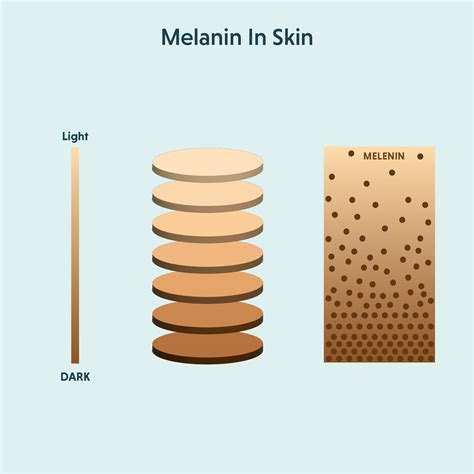
Brown spots and sun spots, often referred to as “age spots” or “liver spots,” are flat areas of increased pigmentation that develop on the skin’s surface. Sun spots are a specific type of brown spot caused by prolonged UV exposure. When ultraviolet rays penetrate the skin, they stimulate the production of melanin, the pigment responsible for skin color.
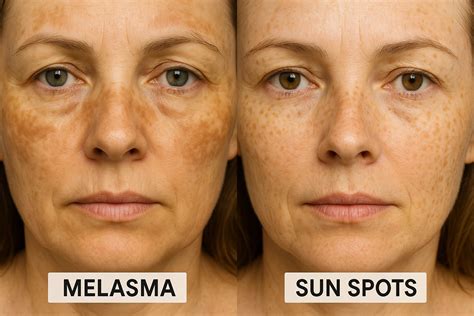
While brown spots and sun spots share similar characteristics, melasma is a distinct condition that also involves hyperpigmentation. Melasma is most common in women and is often triggered by hormonal fluctuations, particularly during pregnancy or while taking birth control. Unlike sun spots, which are usually small and round, melasma tends to form larger, uneven patches.
Causes of Brown Spots
The primary cause of brown spots and sun spots is exposure to ultraviolet (UV) radiation from the sun or artificial sources like tanning beds. This exposure leads to:
Uneven Pigmentation
To protect itself from the damaging effects of the sun, the skin makes more brown pigment, called melanin. That extra melanin is what creates a suntan. But sometimes, skin doesn't make melanin evenly. As a result, the skin's coloring, called pigmentation, looks patchy. The sun also can cause small blood vessels to stretch, giving skin a blotchy look.
Photoaging
Photoaging is the premature aging of your skin due to ongoing exposure to ultraviolet A (UVA) and ultraviolet B (UVB) radiation. Photodamage can come from natural UV radiation exposure from the sun or artificial UV light sources. UV exposure not only ages your skin more quickly than it naturally would, but can also increase your risk for skin cancer. Photoaging is also called sun damage, solar damage, dermatoheliosis, and photodamage.
Chronological skin aging is the natural aging of your skin according to your age and genetics; it is not preventable. Photoaging is caused by a lifetime of UV radiation exposure, mostly from the sun. Photoaging causes DNA changes in the cells of your skin and can lead to cancer. If you take precautions, photoaging can be significantly reduced.
The sun's ultraviolet radiation breaks down the connective tissue - collagen and elastin fibers - that lies in the deeper layer of the skin. Without that supportive connective tissue, the skin loses its elastic quality. This condition is called solar elastosis. Skin affected by solar elastosis has deep wrinkles that don't disappear when stretched, and the skin may also look yellow.
Sunspots (Solar Lentigines)
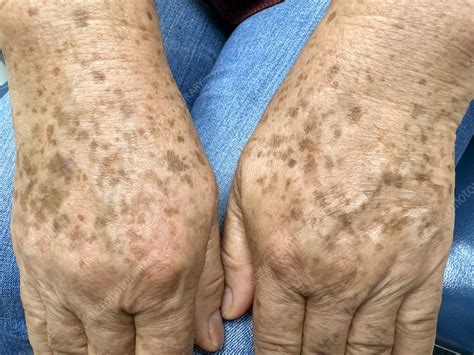
Solar lentigines are flat spots that are darker than the skin around them. They are usually tan, brown, or dark brown, depending on skin color, and are typically darker than freckles. Solar lentigines usually have oval to round shapes with uneven edges and can be of different sizes. They tend to show up on areas most exposed to the sun, such as the head, face, hands, arms, and upper body. Also called liver spots, they are common in older adults, but children with white skin who spend a lot of time in the sun may also develop them. With age and more time outdoors, people tend to develop more solar lentigines. Sometimes they appear in large numbers. Unlike freckles, solar lentigines don't tend to fade during colder months.
Many people notice they develop brown spots after sunburn once they turn 50, but you don’t have to be 50 to develop sunspots on your skin. Brown spots, also known as age spots or liver spots, are a sign you’ve been exposed to the sun too often and your skin is attempting to protect itself from more sun damage. Spending more time out in the sun isn’t the only reason you may be more likely to develop brown spots after sunburn. Since they’re caused by UV rays, these brown spots commonly develop on the hands, arms, shoulders, and face. You may notice they are grouped together. If you have been sunburned multiple times throughout your life, there is a high probability that you will develop brown spots.
Age spots are small, flat dark areas on the skin. They vary in size and usually appear on areas exposed to the sun, such as the face, hands, shoulders, and arms. Age spots are very common in adults older than 50, but younger people can get them if they spend time in the sun. True age spots don't need treatment, but they are a sign the skin has received a lot of sun exposure and are an attempt by your skin to protect itself from more sun damage. For cosmetic reasons, they can be lightened or removed.
Melasma
Melasma (muh-LAZ-muh) is a darkening of skin on the face, sometimes called the mask of pregnancy. Dark patches usually appear on the forehead and cheeks. Melasma can get worse after time in the sun. Melasma often affects Black, Asian, and Hispanic people, people who use birth control pills or hormone therapy, and people in their second or third trimester of pregnancy. Melasma might fade after the birth of a baby, during the winter months, or when a person stops taking birth control pills, but it can also last for years.
Labial Lentigo
A labial lentigo is a harmless, small, flat, brown spot on the lip, also called a labial melanotic macule. It can appear after spending time in the sun. In most cases, labial lentigo forms on the lower lip.
Poikiloderma
Poikiloderma (POI-kih-loe-DUR-muh) appears as areas of uneven coloring on the skin. It's most common on the areas of the neck and upper chest that are often exposed to sunlight. If those areas continue to be exposed to the sun, poikiloderma can get worse over time.
Actinic Keratosis
Actinic keratosis (ak-TIN-ik ker-uh-TOE-sis) looks like a rough, scaly patch on the skin. The color may be from tan or red to brown, depending on skin color. Actinic keratosis is also called solar keratosis. It's commonly found on areas of the skin often exposed to sunlight in people who have white skin. Sometimes, actinic keratosis may develop into a type of skin cancer called squamous cell carcinoma. Because there's no way to tell if one of these patches will become cancer, all actinic keratoses need treatment.
Lentigo Maligna
Lentigo maligna is a type of growth that develops on areas often exposed to the sun over a long period of time, including the face, arms, and legs. Lentigo maligna starts as a flat spot with an uneven shape that slowly gets bigger. When it first appears, a lentigo maligna usually is brown or brown-black. Later, it might develop red and white patches. Over time, the spot may turn into melanoma, a type of skin cancer that begins in the top layer of skin and then moves to the layers of skin underneath.
Distinguishing Brown Spots from Other Skin Conditions
It's important to distinguish sunspots from other skin conditions, especially skin cancer. While sunspots are harmless, certain features can help differentiate them:
- Sunspots: Flat areas of skin discoloration that can be tan or varying shades of brown. They appear on parts of the body that get the most sun exposure.
- Melasma: Brown or gray-brown patches, usually on the face, often larger and more uneven than sunspots.
- Freckles: Flat, brown spots that become more prominent in the summer and fade in the winter. They are an inherited feature and become less noticeable with age.
- Birthmarks: Can be flat or raised, and vary in color and size. Most are harmless, but some can be associated with health problems.
- Skin Cancer: A new, changing, or growing mole or spot is a warning sign. Lesions that itch, bleed, or don’t heal, or have irregular borders, should be evaluated by a doctor.
Sunspots are harmless, but any spot that grows quickly, changes in appearance, or seems unusual should be evaluated by a doctor. Sunspots don’t require any treatment and true sunspots are noncancerous and cannot become cancerous. They can be removed for cosmetic reasons, but leaving them doesn’t pose any risks to your health.
Risk Factors for Sun Damage
Everyone is susceptible to sun-damaged skin. However, you’re more at risk if you:
- Have a light skin tone.
- Have had skin cancer or have a family history of skin cancer, especially melanoma.
- Have many moles.
- Have freckles and burn before tanning.
- Have blue or green colored eyes, or blond, red, or light brown hair.
- Live or vacation at high altitudes.
- Get intense sun exposure on weekends while spending weekdays mostly indoors.
- Spend a lot of time outdoors and/or at tanning salons, especially as a child or teenager.
People of all skin tones are exposed to UV radiation, which increases the risk of sun-damaged skin. However, people of color are less likely to get sunburned because they have more melanin, which offers some protection. Even so, brown or Black skin can still be damaged by the sun, leading to wrinkles and uneven color. While the relationship between sun exposure and skin cancer is well-established for lighter-skinned people, more research is needed for dark-skinned individuals, who may develop skin cancer on the palms of their hands or soles of their feet, often at a later stage.
Certain health conditions and medications can also increase your risk for sun-damaged skin:
- Autoimmune diseases (e.g., lupus) or conditions that weaken the immune system (e.g., HIV).
- Organ transplant recipients.
- Medications that weaken the immune system (e.g., corticosteroids, biologics).
- Medications that make skin more sensitive to sunlight (e.g., certain antibiotics, oral contraceptives, cholesterol-lowering drugs).
How UV Causes Cancer and Aging
Preventing Brown Spots
Preventing pigmentation is easier than treating it. The most effective way to prevent sunspots and other sun damage is to protect your skin from UV rays:
Use Sunscreen Daily
Choose a broad-spectrum sunscreen with SPF 30 or higher. Apply it generously every morning and reapply every two hours when outdoors, or more often if swimming or sweating. On uncovered skin, use a broad-spectrum sunscreen with a sun protection factor (SPF) of at least 30. Apply sunscreen generously and reapply every two hours, or more often if you're swimming or perspiring.
Cover Up
For the most protection from the sun, cover your skin when you're outdoors. Dark clothing with a tight weave offers more protection than light-colored clothing or clothing with a loose weave. Try outdoor gear designed for sun protection; check the label for its ultraviolet protection factor (UPF). A wide-brimmed hat or umbrella can shade skin that can't be covered, in addition to sunscreen.
Seek Shade and Limit Exposure
Stay in the shade as much as you can. The sun's rays are strongest between 10 a.m. and 4 p.m., so try to schedule outdoor activities for other times of the day if possible. If you must be outside during the middle of the day, try to limit the time you're in the sun.
Be extra careful around water, snow, concrete, and sand because they reflect the sun's rays. Sunlight is also more intense at higher altitudes.
Treatments for Brown Spots
While at-home skincare can help reduce mild discoloration, professional treatments often deliver more dramatic and long-lasting results for brown spots and hyperpigmentation. It's important to consult a dermatologist to ensure any dark spots are not harmful and to determine the best treatment plan.
Laser and Light Therapies
- BBL (BroadBand Light) Therapy: This therapy uses targeted light energy to gently heat the upper layers of the skin. The light energy is absorbed by the pigmented areas, breaking down excess melanin and stimulating the skin’s natural healing process. BBL treatments are non-invasive and require little to no downtime.
- PicoSure Laser: This picosecond aesthetic laser is designed to treat pigment issues with exceptional precision and minimal discomfort. It works by delivering ultra-short bursts of energy that shatter the pigment particles responsible for discoloration. This laser treatment is particularly effective for stubborn pigmentation and melasma because it minimizes the risk of post-inflammatory hyperpigmentation or skin lightening.
- Excel V Laser: This laser specifically targets red and brown structures in the skin. The skin cells in the targeted brown spots break apart post-procedure and are eventually eliminated by the body.
Chemical Peels
Chemical peels use acids to remove the outer layers of skin, revealing smoother, less pigmented skin underneath. Different types of peels exist, including superficial peels (using alpha hydroxy acids) and medium peels (using glycolic or trichloroacetic acid). Medium peels require more extensive post-care.
Photodynamic Therapy (PDT)
PDT treats brown spots by using a photosensitizing drug applied to the skin, followed by exposure to a specific light. This activates the medication, destroying damaged skin cells. Following PDT, the skin is extremely sensitive to the sun for a period.
Topical Treatments and Skincare Lines
Award-winning skincare lines, such as ZO Skin Health® and Colorescience®, are chosen for their proven ability to target pigmentation and improve skin health. Other treatments like bleaching creams, liquid nitrogen, and topical benzoyl peroxide can also make age spots less obvious.
Milwaukee Laser & Body Aesthetics provides a comprehensive approach to skin rejuvenation, with personalized treatment plans designed to address concerns like hyperpigmentation and sun spots. Each client begins with a complimentary consultation to evaluate their skin and discuss goals.
When to See a Doctor
While sunspots and age spots are generally harmless, it is crucial to have any new, changing, or unusual skin spots evaluated by a dermatologist. According to the Skin Cancer Foundation, 1 in 5 Americans will develop skin cancer by the age of 70. A dermatologist can help distinguish between harmless pigmentation and potentially cancerous growths.
See your health care professional if you notice:
- A new skin growth.
- Changes to a mole you already have (size, shape, or color).
- A mole that bleeds or becomes itchy or painful.
- Any skin changes that are out of the ordinary for you.
- A spot that grows quickly, changes in appearance, or seems unusual.
Annual skin cancer screenings are recommended to monitor existing brown spots and identify new ones for timely treatment.