The practice of scalping, a brutal act often associated with warfare and violence, has left behind a trail of survivors whose stories illuminate the harsh realities of the American frontier. These individuals, who endured the horrific experience of having their scalps removed and miraculously survived, became living testaments to the violence of the era and played a complex role in shaping the narratives of the American West.
The Grisly Artifact of Omaha
One of the most unusual and grisly items in the Omaha Public Library's collection is a preserved human scalp. Lynn Sullivan, a library specialist and unofficial caretaker of the artifact, described the circumstances surrounding its acquisition.
The artifact's history is tied to the construction of the railroad under the Pacific Railroad Act of 1862, approved by Abraham Lincoln to connect the Missouri River to the Pacific Ocean. While this endeavor aimed to unite the nation, it came at a great cost to Native American tribes, disrupting their hunting grounds and way of life.
On August 6, a group of Cheyenne cut telegraph wires near Plum Creek Station (present-day Lexington, Nebraska). In response, Union Pacific dispatched a five-man crew to investigate. Their handcar derailed due to railroad ties placed on the tracks, leading to a skirmish in which all but one man, Thompson, were killed. Shortly after, a following train also derailed due to an obstruction, marking the first train derailment in U.S. history.
Left for dead, Thompson, who had been scalped and shot, miraculously survived. He reportedly recovered his severed scalp, preserved it in salt, and sought medical attention from Dr. Richard C. Moore in Omaha. Dr. Moore, according to Frank J. Burkley's chronicle of life on the prairie, examined the scalp, noting it was removed from a nine-by-seven-inch area, beginning above the left eyebrow and cut in a diamond pattern-a detail key to identifying the tribe involved.
Thompson's recovery was rapid, despite neuralgic pains. In 1900, he gifted his preserved scalp to Dr. Moore, who subsequently donated it to the Omaha Public Library. Today, it is stored in an archival box and displayed on special occasions, serving as a stark reminder of the violent past.
Stories of Survival and Resilience
The phenomenon of surviving a scalping was not uncommon in early nineteenth-century America, with individuals appearing in regions like Kentucky, Tennessee, and westward. These survivors, products of near-continual conflict arising from American invasions of Native lands, became subjects of print and folklore.
William Thompson's Ordeal
William Thompson's survival is a prominent example. After being shot and scalped during an ambush, he miraculously regained consciousness, retrieved his scalp, and sought medical help. His story, documented by Dr. Moore and recounted by Frank J. Burkley, highlights the medical and personal efforts involved in recovery.
Robert McGee: The "Man with 14 Lives"
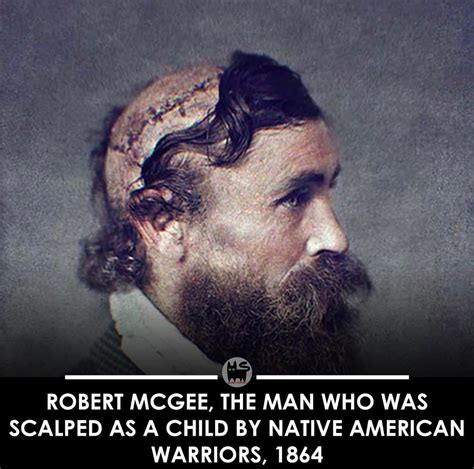
Robert McGee, scalped as a child in 1864 by Sioux, became known as the "man with 14 lives." A photograph from around 1890 shows him displaying his scalping scars. Despite the severity of his injuries, McGee recovered, and eminent surgeons were unable to restore his hair. He used his disfigurement to establish a career in public appearances.
Edward Robinson: A Fur Trader's Tale
Edward Robinson, a fur trader and scalping survivor, was part of John Jacob Astor's expeditions to the Pacific Coast in 1810. Robinson, who had received his scalping years earlier in Ohio Valley Indian wars, wore a scarf around his head. His knowledge of a potentially faster route to the Pacific influenced the decision-making of expedition leader Wilson Price Hunt.
Josiah Wilbarger: A Texas Frontier Survivor
Josiah Wilbarger was another survivor, attacked by Comanche Indians near modern-day Austin, Texas. Accounts of his ordeal, though sometimes embellished in later retellings, underscore the violence of the Texas frontier.
The Cultural Significance of Scalping
Scalping was more than just a violent act; it was a practice embedded in warfare and cultural traditions. It is considered part of the broader practice of taking and displaying human body parts as trophies, possibly developing as an alternative to taking heads, as scalps were easier to transport and preserve.
Historical and Archaeological Evidence
Archaeological evidence of scalping in North America dates back to the pre-Columbian era, with carbon dating of skulls showing evidence as early as 600 AD. Some skulls exhibit signs of healing, indicating that victims occasionally survived.
Historical accounts from various cultures, including Scythians described by Herodotus, Alani by Ammianus Marcellinus, and even instances in England in 1036, point to the widespread nature of scalping across different times and regions.
Scalping in North America
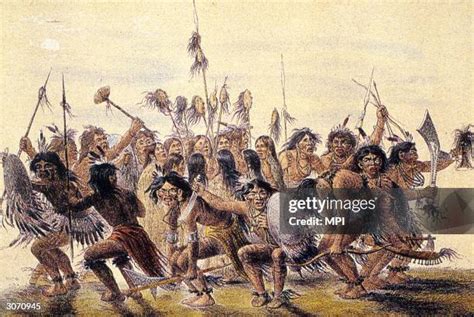
In North America, scalping varied in importance and practice by region. Among Plains Indians, scalps were often taken as war honors, primarily from enemies killed in battle. However, the concept of "total war," where noncombatants were legitimate targets, also applied to conflicts between certain Native American tribes.
Bounties for Indian captives or their scalps were legislated in several English colonies, particularly during periods of conflict like the Susquehannock War and King Philip's War. Both New France and later, American Patriots and British-allied Iroquois, engaged in scalping during colonial wars.
The Role of Scalping in Narratives
Scalping survivors played a significant role in the literature and mythology of the American West. They were often depicted as stock characters, embodying themes of resilience, savagery, and the triumph of the American spirit. Their damaged bodies served as visual evidence for narratives that justified settler colonialism and flattered an emergent nationalism.
In literature, survivors could be portrayed as tragic or valiant, but their stories often served to reinforce the idea of American fortitude in the face of "savage" brutality. This framing, while celebrating expansion, also reflected a national struggle to understand the violence inherent in the conquest of the West.
Scalping in Modern Portrayals: "The Revenant"
The film "The Revenant" (2015), based on the story of Hugh Glass, brought the theme of survival on the frontier to a modern audience. While the film is celebrated for its visceral depiction of the West, it also engages with the historical tropes surrounding scalping survivors.
The character John Fitzgerald, portrayed as a survivor of a scalping by the Arikara, embodies the "revenant" archetype-a man raised from the dead. His brutal recounting of the experience in the film highlights the pain and trauma associated with such an event, complicating audience perceptions.
FAN TRAILER: The Revenant 2 - Leonardo DiCaprio (Parody)
The film's use of historical source material, which often fictionalized suffering to make arguments about Native savagery, is a point of critical discussion. While "The Revenant" aims for historical authenticity, it arguably perpetuates some of the underlying assumptions of nineteenth-century accounts, focusing on white American adversity rather than a deeper interrogation of the violence upon which the West was built.
Fitzgerald's transformation from a scalped survivor to a scalper himself illustrates the cyclical nature of violence and the blurring lines between victim and perpetrator in the frontier narrative. The film's portrayal, while dramatic, reflects a long-standing tradition of using scalping survivors as potent symbols in the American story.